The Quiet Alchemy of Fire and Fog: How East Java’s Highland Flavors Hold the Echo of Ancient Hearths

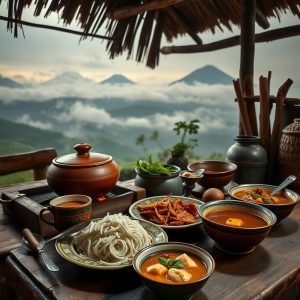
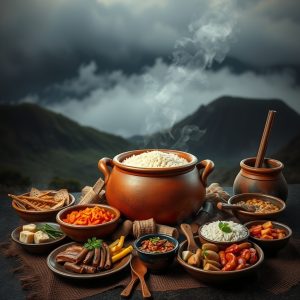
The first time I tasted Nasi Aron Tengger, it was not on a plate but in the memory of the wind. The rice, steamed in bamboo and kissed by the smoke of pinewood fires, carried the weight of something older than hunger—older, even, than the volcano that loomed in the distance, its peak lost in the embrace of dawn’s first light. There was no ceremony, no grand introduction, just a wooden bowl pressed into my hands by a woman whose face was etched with the same lines as the terraced fields behind her. The grains were soft, almost shy, as if they had absorbed the silence of the highlands and were now offering it back, one mouthful at a time.
The Hearth as a Living Archive
In the highlands of East Java, food is not merely sustenance; it is a language spoken in the dialect of fire and fog. Every dish is a fragment of a story, a whisper passed down through generations of hands that have kneaded dough, stirred pots, and tended fires beneath the vast, indifferent sky. Take Wedang Pokak Bromo, for instance—a drink that is less a beverage and more a warm exhalation of the earth itself. The ginger, turmeric, and palm sugar simmer together until the steam curls into the air like the breath of the mountains, thick with the scent of cloves and the faintest hint of woodsmoke. To drink it is to swallow the very essence of the highlands, to feel the slow, steady pulse of the land in your veins.
Or consider Iga Pasir Bromo, the ribs slow-cooked in a pit of sand until the meat falls from the bone like a secret finally revealed. The process is ancient, almost ritualistic, as if the act of burying the meat in the warm embrace of the earth is a way of honoring the land that gives so much. When the ribs are unearthed, they are tender, infused with the smoky aroma of the sand and the faintest trace of sulfur from the volcano’s breath. It is a dish that demands patience, that asks you to wait, to trust in the slow alchemy of heat and time.
The Poetry of Simple Things
There is a quiet poetry in the simplicity of these dishes, a beauty that lies not in complexity but in the way they capture the essence of their surroundings. Sawut Kabut Bromo, a porridge of corn and cassava, is humble in its ingredients but profound in its comfort. It is the kind of dish that warms you from the inside out, its creamy texture a balm for the chill that seeps into your bones in the highlands. The corn, ground by hand, carries the sweetness of the fields, while the cassava adds a earthy depth, a reminder of the soil that nurtures it. It is food for the body and the soul, a reminder that sometimes, the most nourishing things are the simplest.
And then there is Keripik Kentang Sukapura, the crispy potato chips that crackle like the first embers of a fire. Thinly sliced and fried to perfection, they are a testament to the highlanders’ ability to transform the ordinary into the extraordinary. Each bite is a burst of flavor, a celebration of the land’s bounty. They are often eaten with Sego Sambel Tempong, a dish of rice and chili paste so fiery it feels like a challenge, a dare to taste the raw, unfiltered spirit of the highlands. Together, they create a balance—crisp and soft, mild and wild—a harmony that mirrors the landscape itself.
The Language of Smoke and Spice
To eat in the highlands of East Java is to listen to the land speak. The flavors are not just tasted; they are felt, like the vibration of a deep, resonant note. Bledhus Jagung Tengger, the grilled corn slathered in spiced coconut, is a dish that carries the scent of the fields, the sweetness of the kernels mingling with the smoky char of the grill. It is often eaten at dawn, when the mist still clings to the valleys and the air is cool and crisp. The act of biting into the corn, of feeling the warmth of the grill on your lips, is a communion with the land, a moment of connection that transcends the ordinary.
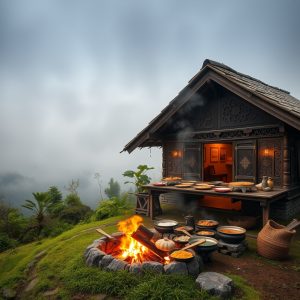
And what of Bakso Bakar Malang, the grilled meatballs that sizzle over open flames, their surfaces caramelizing into a golden crust? They are a dish of contrasts—soft yet firm, savory yet sweet—each bite a reminder of the duality of life in the highlands. The smoke from the grill curls into the air, carrying with it the stories of the people who have gathered around the fire, their laughter mingling with the crackle of the flames. It is a dish that brings people together, that turns a meal into a shared experience, a moment of warmth in the cool mountain air.
The Unseen Threads That Bind
There is a thread that runs through all these dishes, a commonality that ties them together like the roots of an ancient tree. It is the thread of resilience, of adaptation, of a people who have learned to thrive in a land that is both generous and harsh. The highlanders of East Java do not fight the elements; they embrace them, weaving the fog and the fire, the smoke and the spice, into the very fabric of their lives. Their food is a testament to this harmony, a celebration of the land’s gifts and the people’s ingenuity.
Take Cwie Mie Malang, for instance, a dish of noodles that is as much a part of the city’s identity as the mountains that surround it. The noodles, chewy and springy, are tossed with minced pork and a rich, savory broth, each bite a symphony of textures and flavors. It is a dish that speaks of migration, of adaptation, of the blending of cultures that has shaped the region. To eat it is to taste the history of Malang itself, to feel the pulse of a city that has grown and evolved, yet remains rooted in its past.
And then there is Rawon Nguling Pasuruan, a beef soup so dark it is almost black, its color a testament to the richness of the spices that flavor it. The soup is a labor of love, the beef simmered for hours until it is tender enough to melt in your mouth, the broth infused with the earthy aroma of keluak nuts. It is a dish that demands time, that asks you to slow down, to savor each spoonful as if it were a rare and precious gift. In a world that moves too fast, Rawon is a reminder of the value of patience, of the beauty that can be found in the slow, steady simmer of life.
The highlands of East Java are a place of quiet magic, where the land and the people exist in a delicate balance, each shaping the other in ways both seen and unseen. The food of the region is a reflection of this harmony, a testament to the resilience and creativity of the people who call these misty peaks home. To taste these dishes is to taste the very soul of the highlands, to feel the echo of ancient hearths in every bite, to hear the whispers of the land in the crackle of the fire and the steam rising from a bowl of Angsle Hangat Bromo. It is an experience that lingers, not just on the tongue but in the heart, a reminder that sometimes, the most profound connections are the ones we make with the simplest of things.