The Dance of Mist and Maize: A Highland Rhapsody in East Java’s Culinary Whispers
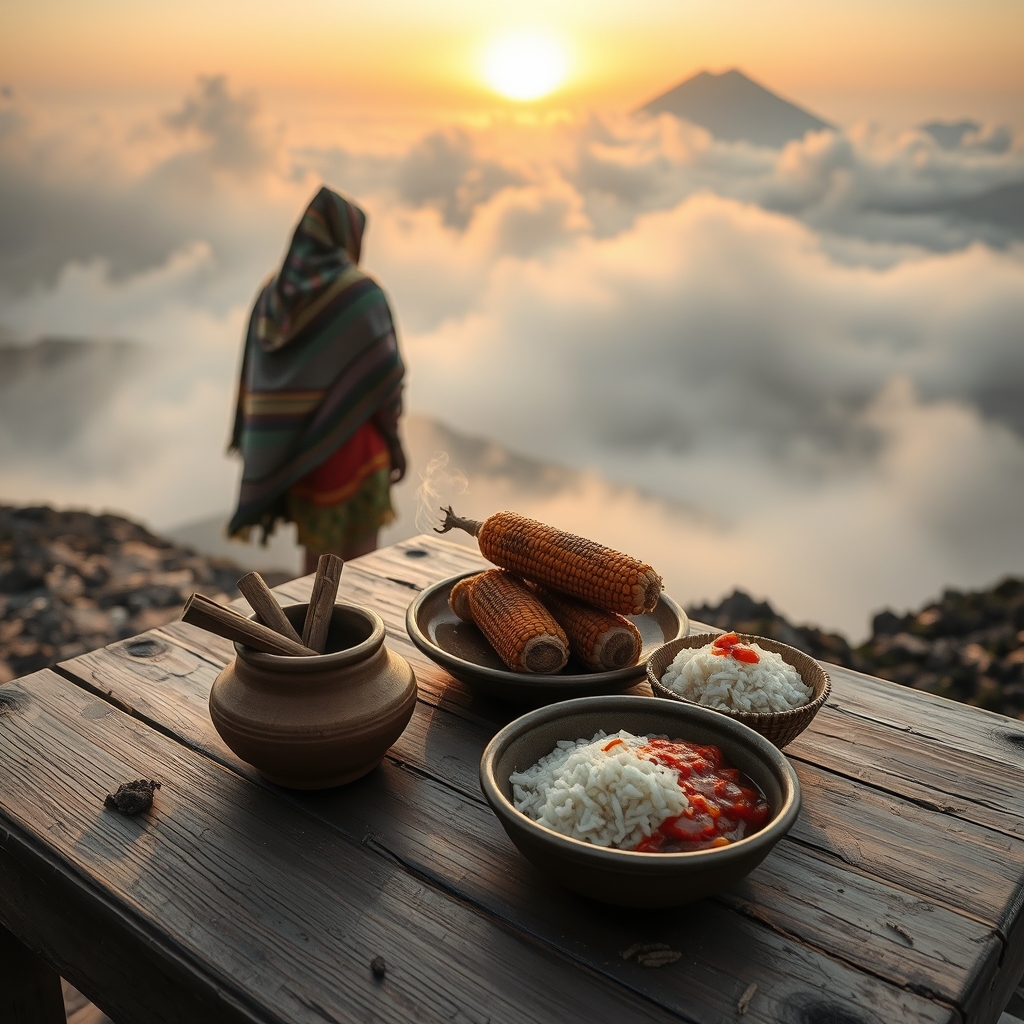
The first light over the Tengger Caldera does not arrive with fanfare. It seeps, like tea leaves unfurling in hot water, through the dense veil of mist that clings to the highlands. There is no grand announcement—only the quiet surrender of night to dawn, a transition so gentle it feels like a secret shared between the earth and the sky. And in this hush, the flavors of the highlands begin their slow, smoldering dance.
The Sacred Embrace of Smoke and Soil
To stand at the edge of Penanjakan at sunrise is to witness the world being painted in strokes of gold and crimson, but it is also to inhale the scent of jagung bakar—charred corn—roasting over open flames. The smoke curls upward, intertwining with the mist, as if the very air is seasoned with the essence of the land. The corn, kissed by fire, carries the sweetness of the soil, its kernels bursting with a warmth that lingers long after the last bite. It is not just food; it is an offering, a communion with the volcano’s ancient breath.
Nearby, the aroma of wedang pokak rises from clay cups, a spiced ginger drink that thrums with the heat of cinnamon and cloves. The Tenggerese people sip it slowly, their hands wrapped around the warmth, as if drawing strength from the earth itself. The drink is more than sustenance—it is a ritual, a way to honor the cold that creeps in with the altitude, a way to say, I am here, and I am alive.
The Poetry of Simplicity
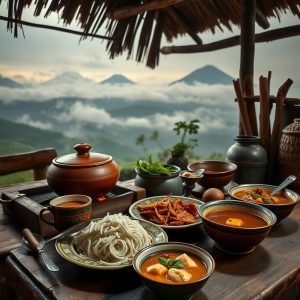
In the highlands, simplicity is not a lack—it is an art. Take sego sambel tempong, a dish so unassuming it might be overlooked, yet so profound it could bring a grown traveler to their knees. The rice, steamed to perfection, is a canvas for the sambal, a fiery concoction of chili, shallots, and shrimp paste that crackles with intensity. Each bite is a revelation: the softness of the rice yielding to the sharp, electric heat of the sambal, a balance so delicate it feels like a metaphor for life itself. Too much heat, and the harmony is lost. Too little, and the soul remains untouched.
Or consider bledhus jagung Tengger, a dish of corn and cassava, slow-cooked until the flavors meld into something greater than the sum of their parts. The corn, sweet and tender, cradles the earthy cassava, while the coconut milk wraps around them like a lullaby. It is comfort in its purest form, the kind that doesn’t need adornment because it is already whole.
The Whisper of Tradition in Every Crumb
There is a quiet defiance in the way the people of the highlands preserve their culinary traditions. In a world that chases the new and the novel, they hold fast to the old ways, to the recipes passed down through generations like heirlooms. Nasi aron Tengger, for instance, is not just rice cooked with coconut milk and pandan leaves. It is a story of resilience, of a people who have learned to thrive in the shadow of a volcano, who have turned the harshness of their environment into something beautiful. The rice, fragrant and slightly sticky, is a testament to their endurance, a reminder that even in the most unforgiving landscapes, life finds a way to flourish.
And then there is sawut kabut Bromo, a dish of grated cassava and coconut, steamed until it becomes a soft, pillowy cloud. The name itself—kabut, meaning fog—evokes the mist that blankets the highlands, as if the dish were born from the very essence of the place. It is humble, unpretentious, yet deeply satisfying, like a whispered secret that warms the heart.
The Alchemy of Fire and Time
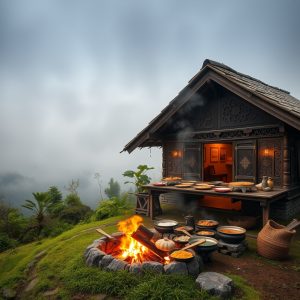
Fire is the silent alchemist of the highlands. It transforms the ordinary into the extraordinary, the raw into the refined. The iga pasir Bromo, ribs slow-cooked in sand until the meat falls from the bone, is a masterclass in patience. The sand, heated by the earth’s own warmth, tenderizes the meat over hours, infusing it with a smoky depth that no oven could replicate. It is a dish that demands time, that refuses to be rushed, and in that refusal, it becomes something sacred.
Similarly, the mendol tempe krispi—crispy fried tempeh fritters—are a celebration of texture and contrast. The tempeh, fermented and dense, is sliced thin and fried until it crackles with each bite. The crisp exterior gives way to a soft, nutty interior, a duality that mirrors the highlands themselves: rugged on the surface, but tender beneath.
The Language of Steam and Silence
In the highlands, food is not just eaten—it is experienced. The steam rising from a bowl of angsle hangat Bromo, a warm dessert of sticky rice balls, coconut milk, and peanuts, carries with it the scent of home. The first sip is a revelation, the sweetness of the coconut milk mingling with the earthy crunch of peanuts, a symphony of flavors that plays out on the tongue like a well-loved song. It is a dish that speaks in whispers, that asks you to slow down, to savor, to be present.
Even the simplest of snacks, like keripik kentang Sukapura, thin slices of potato fried to a golden crisp, tell a story. The potatoes, grown in the volcanic soil, carry the mineral richness of the earth, their flavor intensified by the high altitude. Each chip is a crisp, salty ode to the land, a reminder that even the smallest things can carry the weight of a place.
The highlands do not shout their beauty. They do not need to. Their flavors, like the mist that rolls over the plateaus, are subtle yet inescapable. They seep into your bones, into your memories, until you find yourself craving not just the taste, but the feeling—the quiet awe of standing on a ridge at dawn, the warmth of a clay cup in your hands, the slow, smoldering dance of smoke and spice. These are not just meals; they are moments, strung together like beads on a necklace, each one a reminder of the sacred, the simple, the sublime.
The last light of day fades over the Tengger Caldera, and the mist begins to rise once more. The flavors of the highlands linger, not just on the tongue, but in the soul, a quiet echo of a place where the earth breathes and the fire sings. There is no need for grand gestures here—only the steady, unshakable truth that some things, like the taste of jagung bakar at sunrise or the warmth of wedang pokak on a cold morning, are enough to make the world feel like home.